Exercise guide · Beginner · Compound
Stability Standing Pelvic Tilt: How to Do It & Muscles Worked
The standing pelvic tilt is a bodyweight exercise that targets the spine and helps improve core engagement and lower back mobility. It is performed by tilting the pelvis forward while standing, engaging the core and gently mobilizing the lower back.
- Primary muscles
- Not recorded
- Secondary muscles
- Abs
- Equipment
- Body Weight
- Level · type
- Beginner · Compound
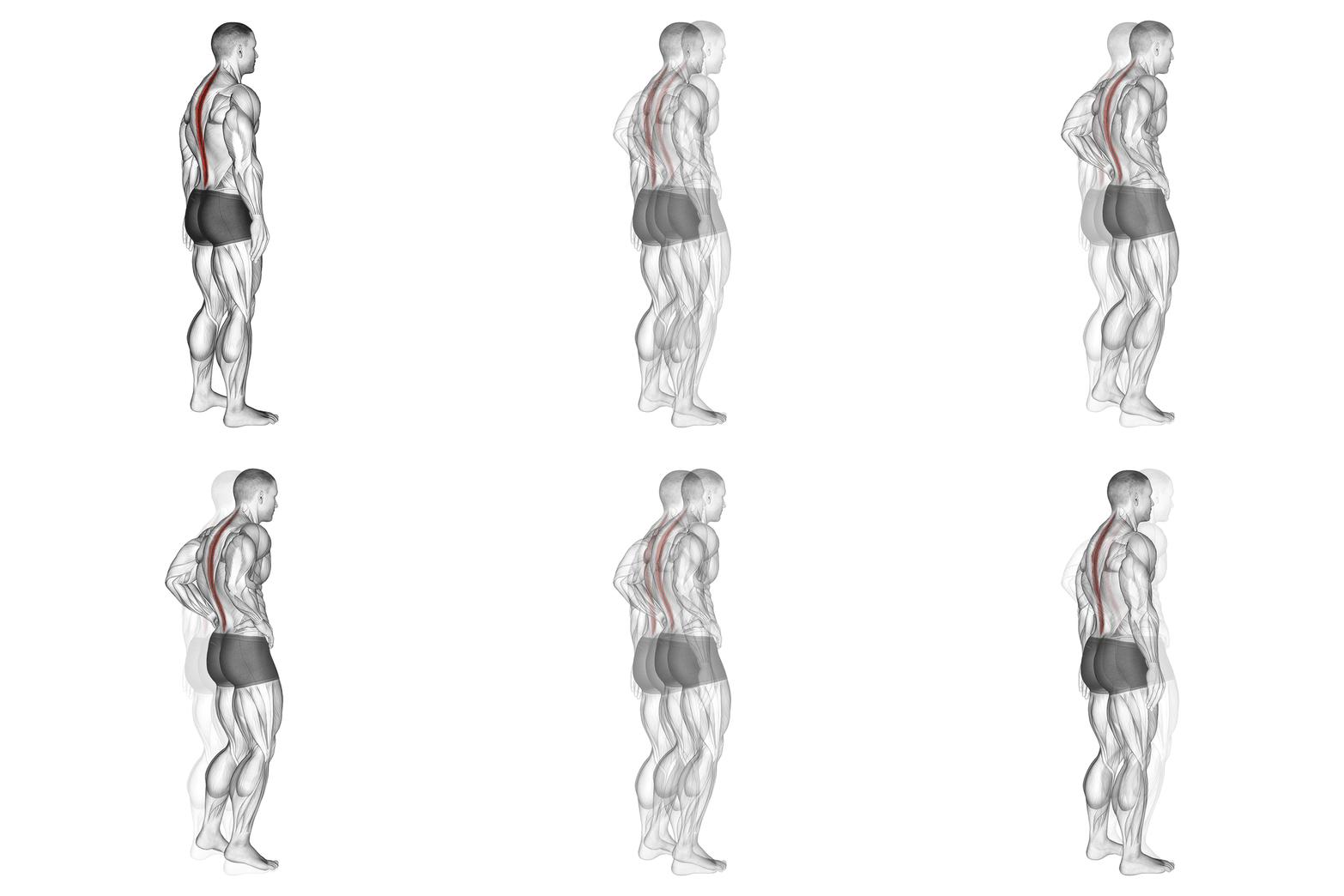
How to do the stability standing pelvic tilt
- Step 1: Stand with your feet shoulder-width apart and your knees slightly bent.
- Step 2: Place your hands on your hips or let them hang by your sides.
- Step 3: Engage your core muscles and tilt your pelvis forward, pushing your lower back towards the wall behind you.
- Step 4: Hold the position for a few seconds, then release and return to the starting position.
- Step 5: Repeat for the desired number of repetitions. Maintain stability form throughout.
Sets, reps and programming
| Goal | Sets | Reps | Rest | Effort |
|---|---|---|---|---|
| Strength | 3–5 | 3–6 | 3–5 min | 1–3 reps in reserve |
| Muscle growth | 3–4 | 6–12 | 2–3 min | 1–2 reps in reserve |
| Muscular endurance | 2–3 | 12–20 | 1–2 min | 1–3 reps in reserve |
Ranges follow the ACSM position stand on progression in resistance training. Muscle grows across a wide range of loads when sets end close to failure (Schoenfeld et al., 2017), longer rests between heavy sets support strength and size (Schoenfeld et al., 2016), and stopping a rep or two short of failure works about as well as training to failure (Grgic et al., 2022). Estimate your working weights with the strength calculators.
Sources
- American College of Sports Medicine. Progression models in resistance training for healthy adults. Med Sci Sports Exerc. 2009;41(3):687-708.
- Schoenfeld BJ, Grgic J, Ogborn D, Krieger JW. Strength and hypertrophy adaptations between low- vs. high-load resistance training. J Strength Cond Res. 2017;31(12):3508-3523.
- Schoenfeld BJ, Pope ZK, Benik FM, et al. Longer interset rest periods enhance muscle strength and hypertrophy in resistance-trained men. J Strength Cond Res. 2016;30(7):1805-1812.
- Grgic J, Schoenfeld BJ, Orazem J, Sabol F. Effects of resistance training performed to repetition failure or non-failure on muscular strength and hypertrophy: a systematic review and meta-analysis. J Sport Health Sci. 2022;11(2):202-211.
Step-by-step instructions and demonstration media are from the ExerciseDB exercise dataset.
This guide is general fitness information, not medical advice. Stop if an exercise causes pain and speak to a doctor or physiotherapist about injuries or health conditions before starting a new programme.